
Table of contents
- Sports Knee Injuries: What Every Active Person Should Know
- Why Are Knee Injuries So Common in Sports?
- Common Types of Sports Knee Injuries
- ACL (Anterior Cruciate Ligament) Injury
- Meniscus Tear
- MCL (Medial Collateral Ligament) Injury
- Patellar Tendinitis (Jumper’s Knee)
- Patellofemoral Pain Syndrome
- Warning Signs You Should Never Ignore
- How Are Sports Knee Injuries Diagnosed?
- Treatment Options for Sports Knee Injuries
- Arthroscopic Knee Surgery
- Can Sports Knee Injuries Be Prevented?
- Recovery and Returning to Sports
- Final Thoughts
- Frequently Asked Questions (FAQs)
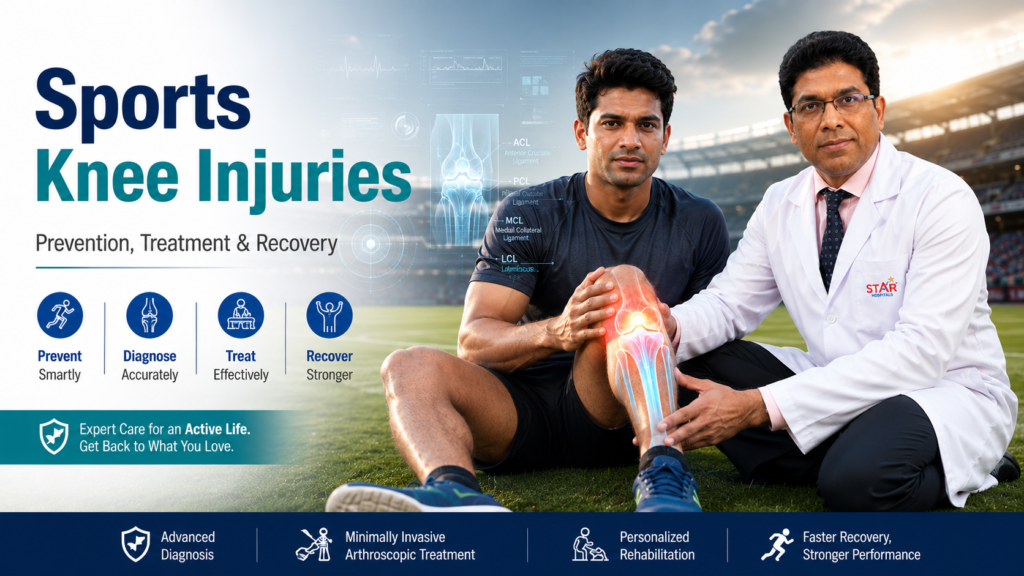
Sports Knee Injuries: What Every Active Person Should Know
Whether you’re a weekend cricket enthusiast, an avid runner, a football player, or
someone who enjoys staying active, your knees work hard every single day. They absorb
impact, provide stability, and allow you to move with confidence. Unfortunately, they are
also among the most commonly injured joints in sports.
A sports knee injury can happen in an instant—a sudden twist while changing direction,
an awkward landing after a jump, or even repeated overuse during training. While some
injuries heal with rest and rehabilitation, others require timely medical intervention to
prevent long-term damage.
Understanding the causes, symptoms, and treatment options for sports knee injuries can
help you recover faster and return to your favorite activities safely
Why Are Knee Injuries So Common in Sports?
The knee is one of the largest and most complex joints in the body. It consists of bones,
ligaments, cartilage, tendons, and muscles working together to provide stability and
movement.
Sports that involve rapid acceleration, sudden stops, jumping, pivoting, or physical
contact place significant stress on the knee. This is why athletes participating in football,
cricket, badminton, basketball, tennis, volleyball, and running are particularly vulnerable.
Common risk factors include:
- Poor warm-up before exercise
- Weak thigh and hip muscles
- Improper sports technique
- Previous knee injuries
- Sudden increase in training intensity
- Inadequate footwear
- Uneven playing surfaces
Common Types of Sports Knee Injuries
ACL (Anterior Cruciate Ligament) Injury
The ACL is one of the primary stabilizing ligaments of the knee. It is commonly injured during sudden twisting movements, quick direction changes, or awkward landings.
Symptoms include:
- A popping sensation
- Immediate swelling
- Knee instability
- Difficulty walking or changing direction
Young athletes involved in football, basketball, badminton, and skiing are particularly at risk.
Meniscus Tear
A The meniscus acts as a shock absorber between the thigh bone and shin bone.
A meniscus tear usually occurs due to twisting while the foot remains planted.
Typical symptoms include:
- Pain during twisting
- Swelling
- Clicking or locking of the knee
- Difficulty squatting
- Reduced range of motion
Small tears may heal with conservative treatment, while larger tears often require arthroscopic repair.
MCL (Medial Collateral Ligament) Injury
The MCL is located on the inner side of the knee and is frequently injured by direct blows to the outside of the knee.
Symptoms include:
- Pain along the inside of the knee
- Swelling
- Tenderness
- Feeling of instability
Many MCL injuries recover successfully with bracing and physiotherapy.
Patellar Tendinitis (Jumper’s Knee)
Repeated jumping sports place excessive stress on the patellar tendon.
This overuse injury commonly affects:
- Volleyball players
- Basketball players
- Runners
- High jump athletes
Symptoms usually begin gradually and worsen with continued activity.
Patellofemoral Pain Syndrome
Often referred to as “Runner’s Knee,” this condition causes pain around the kneecap.
It is frequently caused by:
- Muscle imbalance
- Overuse
- Poor running mechanics
- Weak hip muscles
Fortunately, most patients improve with targeted strengthening exercises.
Warning Signs You Should Never Ignore
Many people continue playing despite pain, hoping it will improve on its own. Delaying treatment may worsen the injury.
Consult an orthopaedic specialist if you experience:
- Sudden swelling after injury
- A popping sensation
- Knee giving way
- Inability to bear weight
- Locked knee
- Persistent pain lasting more than a few days
- Recurrent swelling after sports
Early diagnosis often leads to better outcomes and faster recovery.
How Are Sports Knee Injuries Diagnosed?
An orthopaedic surgeon begins with a detailed clinical examination and understanding of how the injury occurred.
Depending on the suspected injury, investigations may include:
- Digital X-rays
- MRI scan
- Ultrasound (for selected tendon injuries)
- Diagnostic arthroscopy in specific cases
A precise diagnosis helps create the most effective treatment plan.
Treatment Options for Sports Knee Injuries
Treatment depends on the severity and type of injury.
Non-Surgical Treatment
Many sports injuries recover without surgery.
Treatment may include:
- Rest and activity modification
- Ice therapy
- Compression bandage
- Elevation
- Anti-inflammatory medication
- Knee brace
- Physiotherapy
- Sports-specific rehabilitation
Rehabilitation focuses on restoring strength, balance, flexibility, and confidence.
Arthroscopic Knee Surgery
When conservative treatment is insufficient, minimally invasive arthroscopic surgery may be recommended.
Common arthroscopic procedures include:
- ACL reconstruction
- Meniscus repair
- Meniscus trimming
- Cartilage procedures
- Removal of loose bodies
Arthroscopy uses small incisions, resulting in less pain, quicker recovery, and earlier return to activity compared to traditional open surgery.
Can Sports Knee Injuries Be Prevented?
Although not every injury is preventable, your risk can be significantly reduced.
Follow these preventive measures:
- Warm up before every workout
- Strengthen quadriceps, hamstrings, hips, and core muscles
- Improve balance and coordination
- Wear appropriate footwear
- Increase training intensity gradually
- Learn proper landing and cutting techniques
- Avoid overtraining
- Allow adequate recovery between sessions
Preventive exercise programs have been shown to reduce ACL injuries in athletes.
Recovery and Returning to Sports
Returning to sports too early increases the risk of reinjury.
Recovery depends on:
- Injury severity
- Type of treatment
- Rehabilitation commitment
- Individual healing response
Most athletes return safely only after achieving:
- Full knee movement
- Good muscle strength
- Excellent balance
- Pain-free function
- Clearance from their orthopaedic surgeon and physiotherapist
Patience during rehabilitation often determines long-term success.
👉 For more detailed medical information on knee injuries, you can refer to the National Institutes of Health (NIH): Knee Injuries
(https://www.niams.nih.gov/health-topics/knee-problems)
Final Thoughts
Sports keep us healthy, active, and confident, but knee injuries can interrupt both athletic performance and everyday life. Fortunately, advances in sports medicine, physiotherapy, and arthroscopic surgery allow most patients to recover successfully and return to the activities they enjoy.
Ignoring persistent knee pain can lead to further damage. Early evaluation, an accurate diagnosis, and individualized treatment remain the key to a safe and complete recovery.
Whether you’re a recreational athlete or someone simply trying to stay fit, protecting your knees today can help you remain active for years to come.
Frequently Asked Questions (FAQs)
1. What is the most common sports knee injury?
ACL injuries, meniscus tears, MCL injuries, and patellar tendinitis are among the most common sports-related knee injuries.
2. How do I know if my knee injury is serious?
Immediate swelling, inability to bear weight, instability, locking, or persistent pain should be evaluated by an orthopaedic specialist.
3. Can a torn ACL heal without surgery?
Partial ACL injuries may be managed conservatively in selected patients, but complete tears in active individuals often require reconstruction for optimal stability.
4. How long does recovery from a sports knee injury take?
Recovery varies from a few weeks for minor sprains to 6–12 months after ACL reconstruction, depending on rehabilitation and individual healing.
5. Is walking good after a knee injury?
Gentle walking may be beneficial for some injuries, but weight-bearing should be guided by a healthcare professional based on the type and severity of the injury.
6. Can physiotherapy prevent knee surgery?
Many ligament sprains, overuse injuries, and patellofemoral pain syndromes improve significantly with structured physiotherapy, potentially avoiding surgery.
7. When should I see an orthopaedic surgeon for knee pain?
If knee pain persists beyond a few days, is associated with swelling, instability, locking, or affects daily activities or sports performance, seek specialist evaluation.
👉 To understand available treatment options for knee injuries,
visit: https://orthopaedicdrshashikanth.com/treatments/